If you feel stuck at B2 German, you’re definitely not alone. B2 is one of the most challenging levels, but it’s also a major milestone. B2 will open many doors in Germany, from better job opportunities to more meaningful conversations with German speakers.
This level isn’t just about learning more grammar and vocabulary. You are becoming more fluent, expressing your opinions, and understanding complex conversations.
Over the years, I’ve taught German to thousands of students through my YouTube channel and our online courses. So in this guide, I’ve put together everything you have to know about the B2 level and how overcome the infamous B2 plateau.
What is B2 German
B2 is the fourth level of the Common European Framework of Reference for Languages (CEFR). It is considered upper-intermediate.
At B1, you can handle everyday conversations and explain simple opinions. At B2, you should be able to discuss more complex topics, understand longer texts, and express your ideas in greater detail.
Notice how the B2 sentence is more nuanced and considers different perspectives.
If you learn B2 properly, you can get very close to conversational fluency. You still make mistakes but expressing yourself in German becomes more effortless and you have to do very little direct translation in your head.
How long does it take to learn German B2?
If you’ve already completed B1, you should plan around 250 to 350 hours to learn B2. This is roughly the tine it takes to be exam-ready. For broader B2 language skills, like confident speaking and writing, you will need around 500 to 600 hours.
This is based on our data after teaching thousands of students. For a more detailed breakdown, check out our complete guide on how long it takes to learn German.
The Reality of Learning B2 German
B2 is a challenging level, and it’s very easy to become complacent. It’s likely that you will experience something called the “B2 plateau”, where you feel like you’re no longer making progress, even though you’re still studying a lot.
At A1 and A2, progress is easier to notice because you’re learning new vocabulary and grammar all the time. But at B2, you already know enough German to communicate in everyday situations. Now, the challenge is to become more fluent, precise, and natural. And these improvements are much harder to notice.
That’s why you need to push yourself even harder and practice things that are slightly outside your comfort zone.
The good thing is that you’ve already completed the previous levels, so you know how to learn a language and have probably developed a study routine that works well for you.
Now, if you’re already comfortable talking about your hobbies, family, and daily routine, don’t spend all your time on those same topics. Challenge yourself with more difficult subjects like politics, technology, education, or environmental issues.
In addition to that, try to answer unexpected questions in German without any preparation. For example, ask yourself: “Sollte künstliche Intelligenz in Schulen eingesetzt werden?” (Should artificial intelligence be used in schools?). Try to explain your opinion spontaneously, give examples, and consider different perspectives.
At B2, your lessons should also be taught mainly in German, with very little or no English. This is a major difference compared to the lower levels. Instead of translating everything into English, you need to get used to understanding and thinking in German.
That’s also why our complete B2 German course is taught in German. This way you have complete immersion and you challenge yourself more. Over time, you’ll develop a “German brain”.
Learn phrases instead of individual words
At A1 and A2, you can get away with learning individual words. But at B2, it’s best to really focus on complete phrases (called “Redemittel”).
For example, instead of only learning “entscheiden” (to decide), learn “eine Entscheidung treffen” (to make a decision).
Instead of just learning “beitragen” (to contribute), learn “einen Beitrag leisten” (to make a contribution).
Some of these common combinations are called Nomen-Verb-Verbindungen (noun verb combinations). These phrases are a useful step towards fluency. They allow you to think less when you are building sentences.
Essential Skill: Discussing different topics
At B2, you need to be able to explain your opinion, give reasons, and discuss the advantages and disadvantages of something. This is also a major focus in the speaking and writing parts of the Goethe B2 exam.
My favorite exercise for B2: Choose a topic and explain both sides of it in German.
For example, let’s take the question: “Sollte man im Homeoffice arbeiten?” (Should people work from home?)
You could start with “Meiner Meinung nach bietet Homeoffice viele Vorteile” (In my opinion, working from home has many advantages).
Then explain why: “Ein großer Vorteil ist, dass…” (A big advantage is that…).
Next, explain the other side with “Andererseits…” (On the other hand…).
And finally, give your conclusion with “Zusammenfassend lässt sich sagen, dass…” (In summary, it can be said that…).
Prepare for the B2 exam
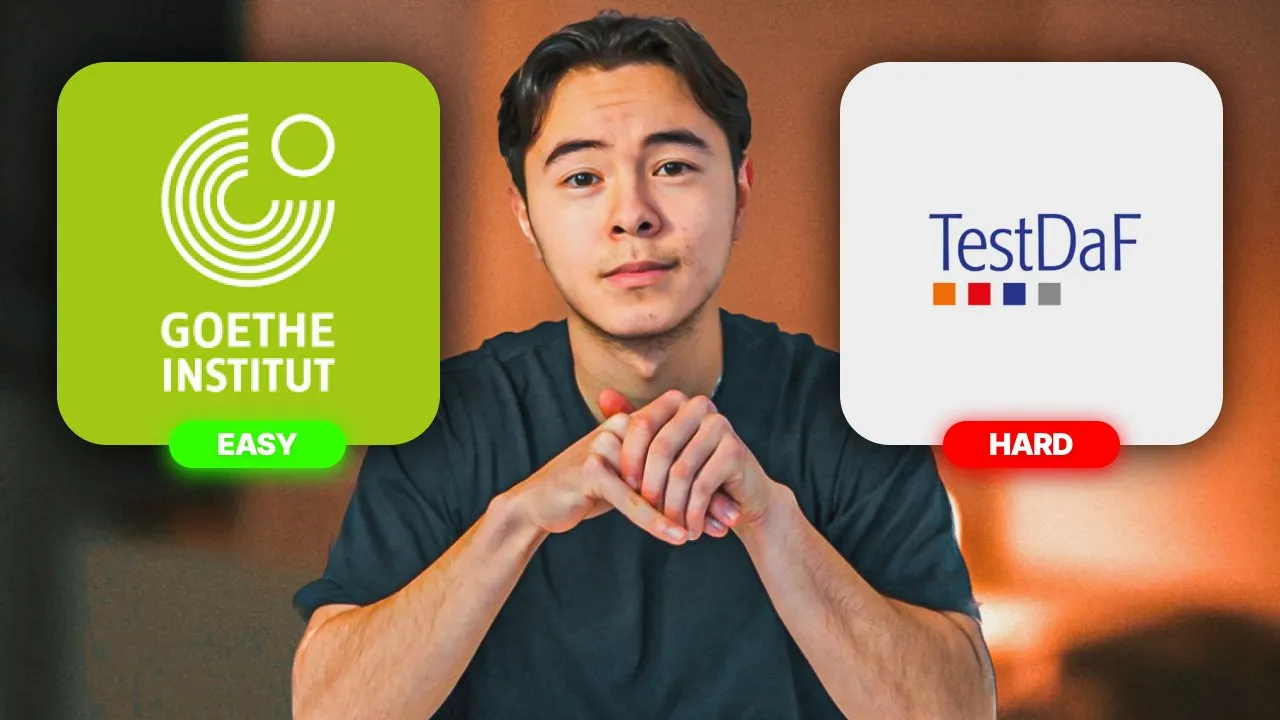
If your goal is to get an official German certificate, allocate some time to prepare for the exam itself. There are multiple recognized German language exams for B2, like Goethe, telc, and TestDaF. We also have a complete guide about the different exams you can take.
Let’s take the Goethe-Zertifikat B2 as an example. It tests four skills: reading, listening, writing, and speaking. The reading exam takes 65 minutes, listening around 40 minutes, writing 75 minutes, and speaking around 15 minutes.
Redemittel are extremely useful in the exam, so make sure to dedicate a lot of time to learning them.
Now in order to optimally prepare, complete as many B2 mock exams as possible under real exam conditions. This way you get used to the questions, understand the time limits, and identify your weaknesses.
Our complete B2 German course also includes Goethe B2 mock exams and a complete exam preparation module to help you practice all four skills and prepare for the real exam.
Follow a structured B2 learning plan
If I could give you once major piece of advice for B2, I’d say this: follow a structured learning plan instead of using random German resources.
At B2, there’s a lot to learn. The hours you spend for this level will be 4 or 5 times as much as for the A1 level. As a result, the volume of content also increases.
If you only watch random YouTube videos or learn topics without a clear plan, it is absolutely deadly at this level. This is also the reason why you hear stories of people who are stuck at B1 or B2 for many years.
In case you want a structured learning path that guides you through B2 step-by-step, check out our SpeedyGerman B2 course. More than 6000 students have used our courses to learn German and pass their language exams.