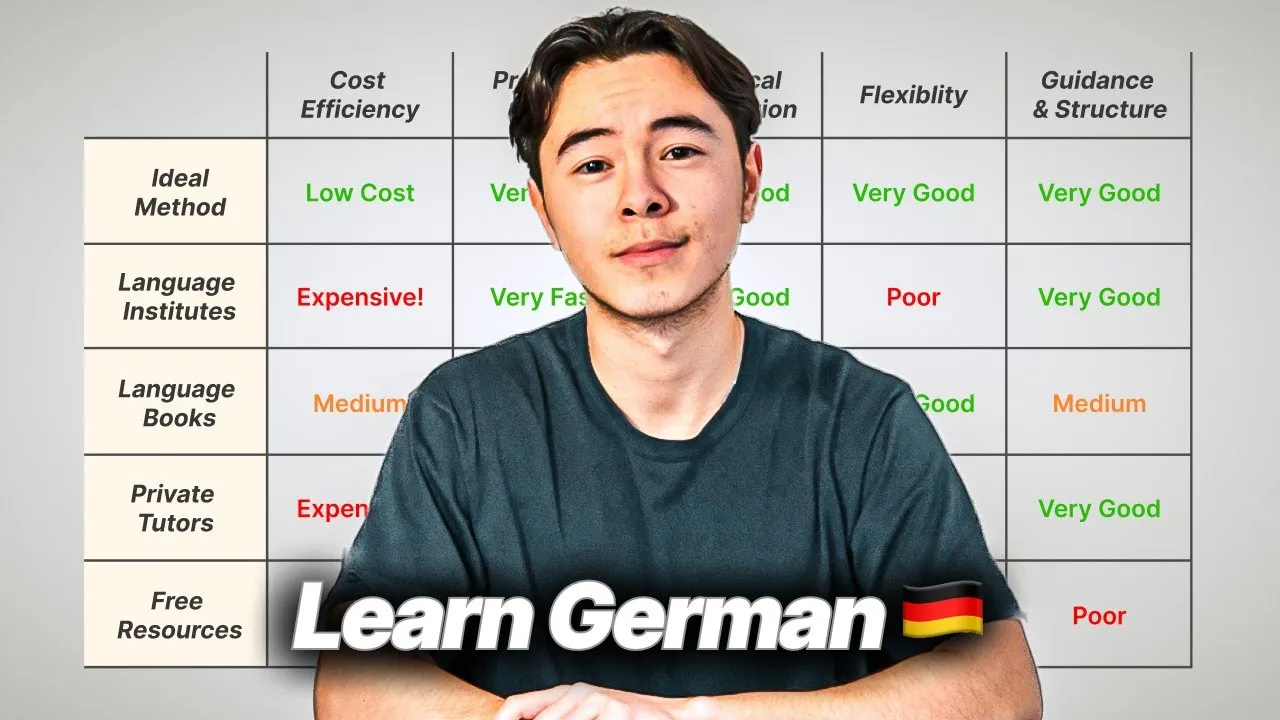
After teaching German to thousands of students on my YouTube channel and in my online courses, I put together the ultimate guide to learn German A1 and actually get started with your language journey. It’s important to take the A1 level very seriously because the habits and foundation you build here will matter when you move on to A2, B1, and beyond.
What is A1 German?
A1 is the first level in the Common European Framework of Reference for Languages (CEFR). The levels go from A1 to C2, and A1 is where you build your foundation.
At this level, you can introduce yourself, ask and answer basic personal questions, and communicate in simple everyday situations. You can understand short conversations when the other person speaks slowly and clearly.
For example, you can say “Ich komme aus Indien” to explain where you’re from, ask “Was kostet das?” when shopping, or order a drink with “Einen Kaffee, bitte.”
Keep your expectations realistic: After learning the A1 level, you won’t be fluent (that usually comes at the C1 level). If you finish A1 and still struggle to understand people in daily life, that’s normal. Everyday conversations are fast, unpredictable, and full of words you haven’t learned yet. It will get better with time.
You can also use our German Level Calculator to get an estimate of where you are.
How long does it take to learn German A1?
My recommendation is that you plan around 60 to 80 hours of focused study for A1. This is roughly the time it takes to be exam-ready and get to a proper A1 level in all 4 areas.
Now, depending on your goal, there is a difference in focus. If you want to pass an A1 language exam, you also need to practice the specific exam tasks and timing. For broader A1 ability, you need to use the language in simple situations beyond familiar practice questions. Ideally, your preparation should cover both.
Confused about how to start learning German? Also check out our free guide on the best way to learn German as a beginner.
Choose one structure and commit to it
If there’s one thing I want you to get right at the beginning, it’s this: choose a clear learning structure and stick with it. I have seen so many students already get this wrong and waste months of their lives.
Now, as a beginner, you don’t yet have enough knowledge to put together your own German curriculum. You might watch a video about articles today, try some random vocabulary tomorrow, and then jump into a grammar topic that assumes you already know five other things. You can spend a lot of time studying like that and still make no progress.
So pick one main resource that takes you through A1 in a proper order. Follow the lessons, do the exercises, and give yourself time to practise each topic. This way you know what you’re working on and what comes next.
We also have a complete A1 course on our website if you want to follow a structured path with video lessons, exercises, and Goethe exam preparation.
Practise all four skills from the beginning
A1 involves speaking, writing, listening, and reading. It’s important to practice all 4 skills consistently.
Speaking: practise saying what you’ve learned without reading it from the page. Introduce yourself, answer a simple question, or describe what you’re doing today.
Writing: make your own sentences and short messages. If your lesson is about daily routines, write a few lines about your actual day.
Listening: use short beginner dialogues and recordings. Listen first, check the transcript if you need it, and then listen again. At A1, it’s a bit too early to consume big podcats or series in German. Do that on the higher levels.
Reading: work with simple texts, notices, and messages. Try to understand the situation and find the useful information, even if a few words are new.
Take the A1 grammar seriously
Many students fail to understand this at the start: the German levels build on each other. When you reach A2 or B1, you’ll still need all the topics you learned at A1.
That’s why you have to take the grammar seriously from the beginning. You don’t need to get every sentence perfect, but you need to understand the basic rules.
For example, when you learn a noun, include its article. Learn “der Tisch” together, so you don’t have to go back later and learn which article belongs to “Tisch.”
And when you learn a grammar rule, put it into a sentence immediately.
So let’s say you’re practising verb forms. Try this: “Ich wohne in München.”“Du wohnst in Berlin.” “Wo wohnst du?”
Here you practice the verb, the sentence structure, and a question you can actually ask someone.
Start speaking from day one
I want you to start speaking as early as possible, ideally from your first day. At the beginning, that might just mean you say your name, where you’re from, and where you live. And then with time, you can add more information.
Of course you’re going to make mistakes, use the wrong article, forget a word, or need some time to put a sentence together. That’s fine at a complete beginner level.
Even the Goethe A1 exam doesn’t require a perfect score to pass. In fact, if you look at the recording of the speaking part of the Goethe A1 exam, the participants make many mistakes, but that doesn’t hurt their score too much, as long as the examiner understands what you mean.
If you’re studying alone, record yourself when you answer a question without your notes. You can also try shadowing: play a short, slow German dialogue and repeat what you hear and copy the speaker’s pronunciation and rhythm. At the beginner levels like A1 and A2, this is extremely effective.
Common mistakes that slow you down
The biggest mistake I always warn beginners about is constantly changing resources. When a topic gets difficult, it’s super tempting to find a new app or start another course. But a new resource won’t solve the problem. It’s just distracting you with something new. So give your chosen structure enough time to work.
Another mistake is moving through lessons without checking what you can use afterwards. Most good resources have some kind of exercise attached to each lesson. So before you start the next lesson, close your notes and actually practice what you’ve learned. Learning German is not just about watching videos. You actively have to use the language (ideally with pen and paper, because this way your brain will absorb the language better).
Also, don’t rush through the basics just because you want to reach B1 or B2 quickly. Keep the timeframe of 60 to 80 hours in mind, because we want to build a stable foundation for future levels. None of my students even regretted taking a bit more time to study a level properly. We also have a detailed guide on how long it takes to learn the German levels.
Watch my A1 Crash Course in 25 Minutes
Millions of students from all over the world have said that this is the best video to start your German learning journey.
Check it out; it’s a completely free video on YouTube, and a native speaker teaches you the basics of German.